“If new information — even true information — enters that realm and they are not able to metabolize it, it gets kicked back out onto the person who noticed it.”
That’s Chris Stephens, CPA, seven minutes into her first Substack Live ever, describing what a gaslighting workplace does with what you hand it. Not malice — a system doing its primary job, which is protecting itself, and the person who saw clearly becomes the thing that has to be managed.
Chris explained there are systems that gaslight, and there are systems that don’t. That distinction matters, because the easy version of this conversation is work is terrible, torch it down, and that’s not what we did. Chris spent thirty years inside functional organizations before she hit the one that broke her, which is exactly what makes her account worth sitting with.
This was our follow-up to Gaslit: A Workplace Dispatch, the composite piece we wrote together — the one where Lula, in real life my goat, walks through five scenes of a workplace slowly rewriting her reality while Mylo, my dog, mocks her stims in meetings. The essay was the pattern. The live was what the pattern feels like from inside it.
A note on how we’re telling this. This isn’t a piece about any one workplace. It’s about the difference between kinds of them — the ones that can take in what you tell them and the ones that can’t — and in our experience that difference comes down to culture nearly every time. Two organizations can share a size and an org chart and still be completely different places to be a person inside. What follows is our lived experience and our read on it and pattern recognition.
Content note: this one names workplace harm, retaliation, burnout, and nervous system collapse. Chris talks openly about the collapse for her, and I talk about CPTSD. Take it at whatever pace you need.
What we’ll get into
What “coherence” means, and why the people who notice incoherence first pay for it first
The single clearest marker of a workplace that won’t gaslight you — and the one time naming the gap actually worked
Careers as ecosystems rather than ladders, and why the capable one ends up holding everything
The frog in the water: how Chris lost interoceptive access without noticing she was losing it
Writing as the thing that put her back together, and what she’s building now
The system that can’t metabolize what you tell it
Chris writes Almost Structured, and she came to Substack a year ago in the middle of collapse — a before and an after, in her framing. She found out she was autistic at roughly the same moment the structure came down, and that timing is neither a coincidence nor rare.
Most of what she writes now circles coherence. Her definition: it lives in systems, anything from a human nervous system up to a whole society, and there comes a point where a system becomes so incoherent that it collapses and must rebuild itself. Neurodivergent people tend to notice the incoherence first. We notice what doesn’t line up. And then, as Chris noted, it stacks in a person.
Someone in the chat put it nicely: you notice problematic patterns others don’t see, you respond to the patterns, and then you get accused of introducing a problem instead of responding to one.
What a healthy system does with what you tell it
I asked Chris to separate the healthy version from the gaslighting one. She warned me she’s generally verbose — hi, same — and then gave me a single marker.
Feedback flows in all directions.
Not up, and not down. Every direction. Across thirty years she’s worked in government, in bootstrapped shops, in mid-sized businesses, and in companies that stayed small in feel long after they went public. The government was the structural outlier: a problem couldn’t be solved by walking over to the peer who could solve it, so information took the long way around, through six people, before it landed. We call it stakeholder management and I think it is a great way to be inefficient.
The nuance matters, because “flat is good, hierarchy is bad” isn’t true and neither of us believes it. Nobody is getting a standing meeting with the CEO of a twelve-thousand-person company unless they are on the leadership team. What you need is a structure that lets the signal survive the trip — one shared place where information lives, and an engagement survey whose results actually come back down to the people who filled it out.
Her best story here is a healthy one. Years ago, at a large company, she was doing predictive analytics — reading demographic data against performance data to work out where the business should expand next. There had been a big internal push around we promote from within. She applied for a step up into management. Someone from outside got hired.
So she went to a senior executive. Not to complain — to name the gap between the message and the behavior: this is what you tell us all the time, and that is not what happened here.
He said: you’re right. We do say that. And thank you for telling me, because nobody ever does.
They moved her into management in a different department, and she kept naming things for thirty years, because for thirty years it kept working. Someone with structural was able to metabolize difficult feedback from an employee without defensiveness.
Now the other version. Someone in the chat named it: managers who say we’re a family, which points to care, and then treat people like machines. But a family doesn’t have the authority to stop your paycheck. She’s worked at companies that used that language and genuinely meant it, and at the end of the day, business dictates. We’re watching that in the current layoff waves, where AI has become the tidy reason code in the HR system for cuts that run into the thousands.
It’s a nice story to tell yourself, though, isn’t it.
Chris pointed out that sometimes the people saying it actually believe it, and I have also personally worked in spaces where there was a family-oriented element. But when somebody points out it isn’t true, the system can’t hold that, and the pointing becomes the problem. Another reader in the chat named the layer underneath — a lot of nice words, and that’s often where it stops. Challenge anyone on what mission or belonging actually means and you’ll get a blank look. (I’m just saying the script. Don’t ask me what’s underneath it.)
Careers are ecosystems, and the capable one carries the ecosystem
Chris started with an accounting degree in the mid-nineties, under a VP of Finance who expected her to interact with every department in the building. She didn’t want to be in accounting. She wanted to see how accounting touched everything else, which for a systems thinker was the happy place — and after that she went wherever her attention pulled her, thirty years of depth and breadth across domains rather than rungs. She now names plainly the thing that hurt her later: she was never building a resume. That wasn’t what she was doing at all.
I recognized my own start in hers. One of my first jobs handed me a stack of hats and let me wear all of them, right up to a direct line to ownership, and then I moved into higher ed and ran into red tape and a decision chain with a lot of links in it. Going from trusted-to-deliver into route-everything is its own kind of injury. Autonomy is huge, Chris said — and in a place with a stay-in-your-lane vibe, where you can see the thing clearly and you’re prevented from even building the relationship with the person who could fix it, it stops being healthy for her. It’s part of why she went back to building her own practice.
But breadth has a cost inside a system, and it lands on the capable one. When someone is one of the only people who can see the whole picture, they often get saddled with work that is far outside their scope. With no recovery anywhere in the role. That’s the mechanism: competence gets metabolized into workload, and the workload never contracts.
The other half of it has a name I only learned recently — threat envy. People watch you become the go-to, and something in that reads as a threat, particularly if you’re gifted and particularly if you’re challenging someone senior to you. Chris gets called intimidating a lot and finds it genuinely confusing, since the people who work with her every day know better. My read, which she can take or leave: it’s a frightening thing to have a truth-teller in a room that isn’t self-assured. It should be a good thing. It just isn’t always received as one.
And hers comes with the fix attached. “I’m not handing you a problem,” she said. “I’m saying, hey, I see this. I can help you fix it.” Almost everything she ever tried to fix was in service of taking the burden off the people around her — information flow and interruption load, an actual stated expectation about when a Slack message needs a response instead of the unspoken rule that everyone answers instantly forever.
Which is where I get loud, because the opposite of nervous system safety at work is the false sense of urgency. What is a fire drill here? I am not performing open-heart surgery. And it trickles down: someone in a senior role can’t manage their own emotions, and everyone underneath in the system absorbs it and passes it along instead of shielding, until it lands on the people actually doing the work as ping ping ping ping, where’s this, where’s that.
Chris’s fix to this: make the implicit explicit. If you don’t tell me you need it Thursday, I’ll do it now, because I can’t sequence what you won’t name. If everything is urgent, nothing is — or everything is, which is worse.
The frog in the water
The gaslighting doesn’t have to be malicious, Chris said. It just has to be persistent, and resistant to the words you’re saying. You notice something and you say it, and you make suggestions, and it isn’t adopted — and not only is it not adopted, the response is no, that’s not a thing, I don’t know what you’re talking about.
Once is nothing. Twice is nothing. But over time it can override a lifetime of calibration. All it takes is one environmental mismatch.
Chris shared that early on it was an energy drain and a cognitive weight she couldn’t name, everything simply becoming harder. And when you’ve been trained your whole life that all you have to do is keep trying, the breaking down is your fault by definition. What was actually happening: she was tracking contradictions. Her brain solves problems, and when the pieces required to close a loop sit outside her control, the loops stay open. They stayed open while she slept.
Eventually it was overcapacity. And then, in her words, she lost interoceptive access. She could no longer tell she was in bad shape.
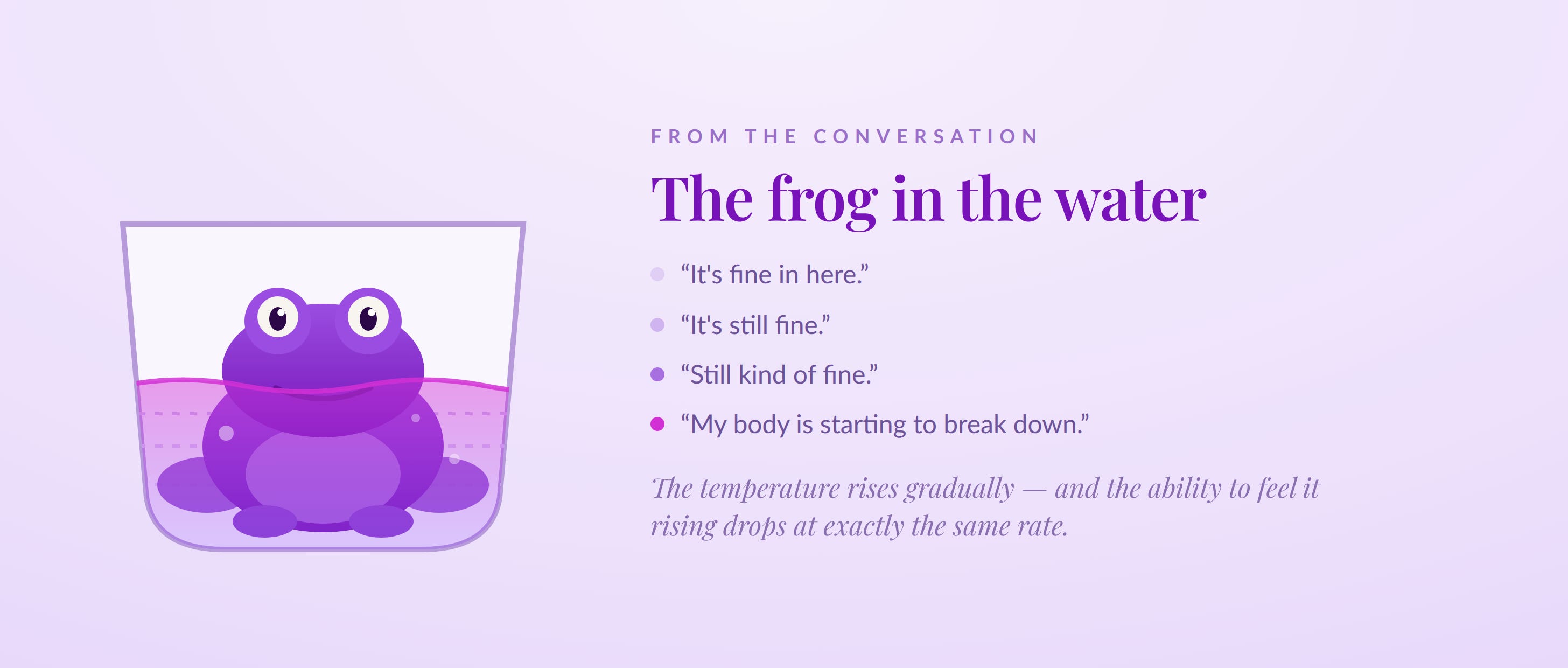
That’s the frog in the water, and she named it as such. It’s fine in here. It’s still fine. Still kind of fine. Oh — my body is starting to break down. Don’t pay attention to that, I need this job, so quiet, I’m not listening to you.
My body was telling me the whole time.
I’m not diagnosing anyone. But I have complex post-traumatic stress disorder, and when Chris said the dreams still come, I felt that in my whole body. Mine got less frequent as I moved through what I moved through. They haven’t gone. That’s what can happen when human biology meets a system that will not bend — a mismatch your body keeps a record of long after you’ve left the building. What she does with hers now is the reframe I’ll be thinking about for a while: she wakes up unsettled and treats the dream as a pointer toward something she hasn’t looked at yet, and she digs.
When you’re in it, it is much harder to see. Only when you are outside looking in and creating space for yourself is it easier to process.
Writing as the way through, and what she’s building now
Chris cannot process without writing. When she’s taken in more than she can hold, it has to move into language before she can integrate it. Her Substack, she said, is essentially her journal, edited for reading. And her whole aim, named at the very end when I asked what she wanted to leave people with:
She’s in the after now, building. She does accounting and bookkeeping for small businesses and bootstrapped founders — the from-scratch kind, where she’ll get on a call before you’ve even opened the business checking account and help you set it up right the first time. She also does decision facilitation, which in practice looks like two business partners who both want something and can’t talk to each other, and Chris meeting each of them separately to find the middle ground they can both live with. Alignment before the lawyers. Her observation, delivered with zero cushioning: partners who skip that will fail, pretty much all of them, because people want to believe the relationship will carry it. It will not. I laughed, because I’ve learned some of that the hard way myself.
She also launched a podcast with her husband, a professional voice actor and improv guy, called Candorland — candor, humor, integrity, empathy, and fact. They record without a script, and at the end of every episode they do the F-bomb: a fact check, so nothing goes into the world wrong. That format isn’t an aesthetic choice. In high-stakes professional settings Chris has to script for every possible question, and without that prep she’ll sometimes experience selective mutism and lose her words entirely. So she built a show that runs associatively, on a few keywords, the way her brain actually works. That’s accommodating yourself out loud, and I’m a huge proponent of it, especially inside systems that won’t do it for you.
Chris shared she is very direct and I cannot imagine wanting anything else in the type of consulting she is offering. The chat spent the whole hour hammering the heart button, which felt like the correct review, and you would never have guessed it was her first live.
I learn so much from Chris’ work with systems and coherence and highly recommend you check out her Substack and chat with her about her service offerings. Chris is also super witty and funny and I love how that came out on the live, she had me giggling!
One honest question
Not should you quit. We’re not telling anyone to quit tomorrow. The question is smaller and harder: is the environment you’re in able to metabolize what you tell it — or does it hand it back to you as evidence that you’re the problem?
Sit with that one. We spend an enormous number of hours at work, and it shouldn’t cost you the version of yourself who shows up at home at night. That’s the whole reason we did this — so that when it’s happening to you, you have the language for it before your body has to make the argument on your behalf.
Find Chris
Chris Stephens, CPA writes Almost Structured, where she works out the late-diagnosed autistic, gifted, and gestalt experience through autotheory and lived insight, and then wanders wherever it needs to go — coherence, metacognition, phenomenology, work, parenting, systems critique. She’s a CPA who builds financial and organizational systems for neurocomplex entrepreneurs, and she hosts Candorland with her husband.
Start here:
- Mapping the Territory of Coherence
- The Map Is Not the Territory
If you’re starting a business, or trying to get aligned with a partner before it gets expensive — crstephens.com/work-with-me. The credential is real, and so is the rest of her.
And if you haven’t read the piece that started this, it’s here: Gaslit: A Workplace Dispatch.
xo Jen