“Vibes and stats.”
That’s how Dr Sam Illingworth summed up his entire growth strategy when I tried to reflect back what I was hearing — and it might be the most honest description of platform-building I’ve heard all year. Not a funnel diagram or a 90-day content calendar someone wants to sell you. Relationships you actually feel, and numbers you actually read.
Sam writes Slow AI here on Substack, and he’s the person I go to when I want to understand what’s actually happening in AI — because he’s a Professor of Critical AI Literacy who reads the research daily and then translates it for the rest of us without telling us what to think. I really admire his ability to connect with people and teach at the same time — the professor never crowds out the human. We’re also friends, which made calling him “Dr. Illingworth” in the intro funny to both of us. He says he only pulls out the full professorial title when the IRS calls. Or when he’s booking a restaurant. It gets him the booth.
This live was a first for Sam — he’s never really pulled back the curtain on how he’s growing his Substack and his social platforms. He did it generously, with real numbers. Here’s what we covered:
How Slow AI went from a standing start in July 2025 to just shy of 20,000 subscribers — the actual levers, with the math
The two kinds of readers every Substack has, and which one we keep forgetting
Pangram, AI detectors, and why Sam’s 2010 PhD thesis got flagged as 70% AI-written
How Sam actually uses AI behind the scenes — five reader personas, a 4 a.m. news email, and the one line he refuses to cross
Imposter syndrome, from a man objectively at the top of his field who still asks “am I a phony?”
The steel-man prompt that keeps AI from becoming your yes-man
The full live is available, just tap above and dive in!
Write for them, not for you
Sam’s first piece of advice sounds simple and almost nobody does it: write something your audience actually finds value in, rather than something you think is interesting. For him that means living in the spaces where people actually talk about AI, then asking which new research would help a non-scientist make sense of what’s worrying them. The zeitgeist decides the topic; the peer-reviewed literature grounds the answer. That’s the whole recipe, and it’s harder than it sounds because it requires you to stop performing your expertise and start listening.
The second piece is the one I’ve lived myself: build a community of practice. Not an engagement pod — Sam was clear about that. “It’s not about creating a false engagement pod where you’re like, you restack me, I’ll restack you. It’s just people that we trust and that we want to engage with.” His ecosystem is a small circle of writers he trusts, people he’s in touch with through notes and DMs almost daily — and, I’m honored to say, me. That ecosystem is where the ideas get pressure-tested, and — as you’ll see in a minute — where imposter syndrome goes to lose.
Recommendations, Notes, and the math nobody does
The two mechanical growth levers, per Sam: recommendations and Notes.
Recommendations account for roughly 30% of his subscribers, which stopped me for a second when he said it. But here’s the part I’d never heard anyone break down. When someone subscribes to a Substack, they’re shown three publications that writer recommends. Sam recommends over 200 Substacks — because he’s generous, and he’ll almost always say yes when someone asks. Which means any one of those 200 has about a three-in-200 chance of appearing when one of his readers subscribes. If he only recommended three? They’d surface every single time. He’s not saying be stingy — he’s saying understand the math of the thing you’re asking for, and the math of the thing you’re giving.
Notes, meanwhile, is his testing ground. He writes every note himself and lines them up with WriteStack so he’s not glued to the app all day. When a note takes off, that’s a signal the idea might deserve a full article. Free market research, run in public.
The two readers you’re writing for
Sam has almost 20,000 subscribers. The most likes he’s ever gotten on a post is just over 500. That gap isn’t failure — it’s two different audiences. There are the people whose inbox your essay lands in, who read faithfully and never once open the app — your open rate is the only place they show up, and they are, in Sam’s words, your primary audience, “which is something I sometimes forget.” And then there are the app people, who comment and restack and make the whole thing feel alive.
If you’re only measuring the visible engagement, you’re grading yourself against the smaller room. The quiet readers in the inbox are the ones you’re actually writing for. I needed that reminder too.
A thousand books in a week
Sam launched a book — Slow AI — and it ticked over a thousand copies the day we went live. For context: he’s published around ten books through traditional academic presses, each read by, in his estimate, a few hundred people, each taking a year to reach print. This one he shipped himself and can revise whenever he wants, full ownership intact — currently priced at 99p, because he’d rather make discernment affordable than gate it. It’s on Kindle Unlimited too, so subscribers read it free. Over a thousand copies, days into launch — that’s not a marketing machine, that’s an audience that trusts him.
The book collects his central idea into one place: knowing when to use AI, and knowing when to leave it alone. Not prompt hacks — the judgment underneath.
The time traveler problem
We had to talk about Pangram — the AI detector Substack announced it was integrating, which let other users scan your posts and stamp them as human-written or AI-generated, with an “AI-assisted” verdict in between. (Substack has since walked parts of this back; you can now disable scanning on your own posts.)
Sam has been publicly working through why detection-by-score is a problem, and he brought receipts. He ran one of his own posts through Pangram: flagged 100% AI-generated. He then ran that same post through a humanizer tool — another AI — and Pangram called the result 100% human. At which point it actually was AI-processed text. The detector got it exactly backwards, twice.
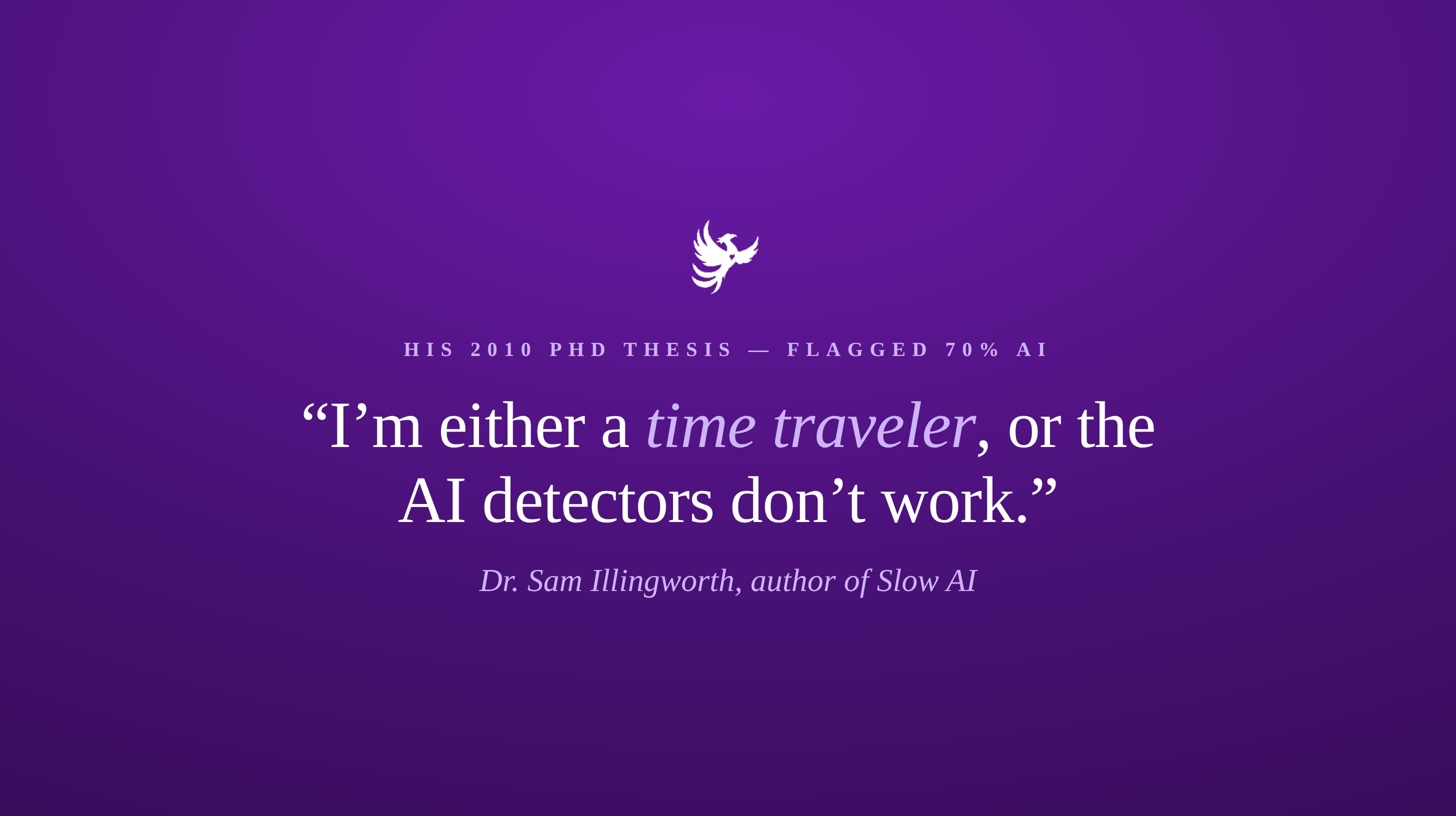
Then there’s my favorite: he ran his PhD thesis — written in 2010 — through a detector, and it came back 70% AI-written. “I’m either a time traveler,” he said, “or the AI detectors don’t work.”
It would be funny if it weren’t landing on real people. The research is troubling: a 2023 Stanford study found that while a small share of native English speakers’ writing got falsely flagged as AI, the false-positive rate for non-native English speakers was over 90%. When you learn a language formally, you write in more structured, more predictable patterns — exactly what detectors read as machine-made. And here’s the part that hits home for this community: neurodivergent writers often write in structured patterns too. The detectors can’t tell the difference between a language model and a mind that simply organizes language differently. Even voice-to-text gets caught — dictate your entirely-your-own words through a transcription tool (such as Wispr Flow AI), and it can come back flagged as 100% AI.
Sam’s position, which I share: a clear, voluntary statement on how you use AI helps readers make informed decisions. A score assigned by a tool with known bias, wielded by strangers, does something else entirely — it manufactures suspicion in a community that runs on trust. And as Sam put it, just because something involved AI doesn’t make it slop. “Has anyone read anything prior to 2022? I will show you the poetry I wrote as a 14-year-old boy. That is slop.”
How Sam bosses the bot
Sam is completely open about how he uses AI, and this section was a quiet masterclass in what I mean when I say Boss the Bot — humans lead, AI assists. A few of his actual systems:
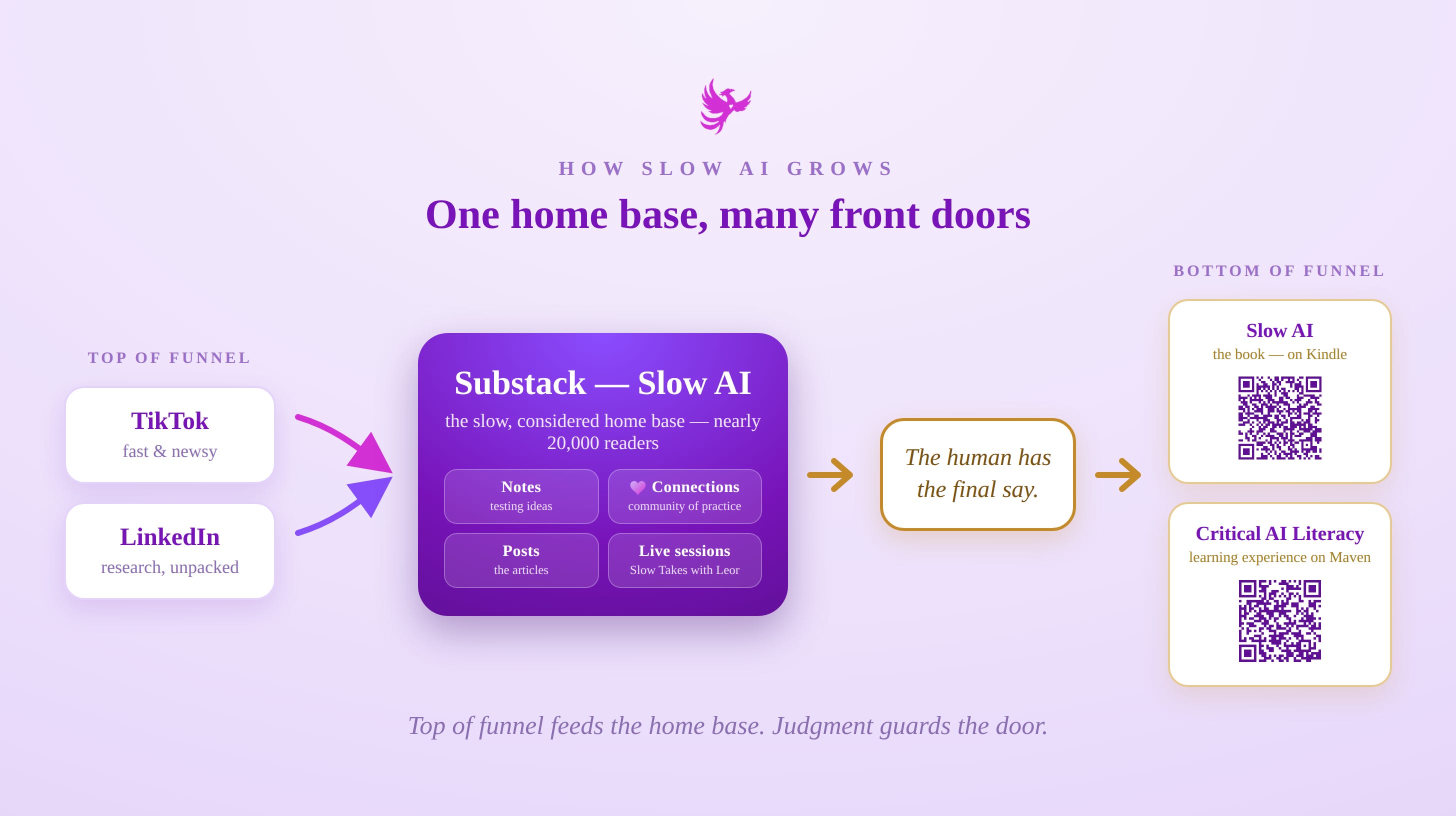
He asks Claude to read his drafts as five different personas of prospective readers — from the devoted to the fully agnostic — and suggest edits that would serve each one. Free market research before a post ever ships. He has a built-in workflow that handles every post’s SEO, down to the URL slug, so the work can actually be found. (I do this too. If you’re not, start — it’s how new readers reach you through a plain Google search.) And after I nudged him onto TikTok a few months ago — one note, “you should really try TikTok” — he built a system that scans AI news overnight and emails him four potential video ideas at 4 a.m. It helps script the short ones and edits his raw phone footage down to the cuts and the end card. He’s around 2,000 followers and climbing, and every video is still his own face and his own judgment.
And then the red line, which he drew so clearly I want it on a poster: he will never let AI post on his behalf. “It would always be me that has the final say and the final push.” The bot drafts, researches, edits, schedules — the human decides. Every time. That’s not a limitation on the system. That is the system.
Cross-posting content
One thing Sam kept coming back to: cross-posting the same content everywhere doesn’t work, because the rooms are different. His LinkedIn — nearly 17,000 followers — leans academic, so on the days he’s not sharing his Substack he reads a research paper and breaks it down for a non-expert audience, and that daily practice has quietly become his number-one growth driver outside Substack itself. TikTok gets the fast, newsy register. Bluesky, where he’s built nearly 18,000 followers, has its own culture again. And Substack gets the slow, considered one. Same person, different registers — he watches the stats on each to learn what every audience actually wants, rather than assuming. Vibes and stats, again. And community!
“Am I a phony?”
Here’s the thing about imposter syndrome that I need you to sit with. Sam is a professor of critical AI literacy. He publishes on it and thinks about it every single day — objectively, he told us, he’s in the top 0.001% of the world on this topic. “That’s just a fact.” And most of the time, he’s still thinking: is this any good? Am I a phony?
If it doesn’t spare him, it was never about competence. It’s the opposite of the Dunning-Kruger effect — the people who know the most doubt the loudest, while the people who know the least post with total confidence. You’ve met both.
His remedy isn’t affirmations. It’s the ecosystem. Not “tell me I’m brilliant” — but “here’s the draft, am I hitting the right notes?” And I’ll tell you honestly: I just did this with him. I wrote a series built on my own research findings, and I felt uneasy about it, because I’m not a researcher by trade — I’ve got a stack of transferable skills and a lot of lived experience, but that credential voice gets loud. So I sent it to Sam and asked him to put his friendly critical research eye on it. Criticism is good as long as it’s kind — and, as Sam added, actionable.
Not forgetting where you came from
I asked Sam how he stays grounded while his numbers climb, and his answer was mostly: the people who knew him first won’t allow otherwise. His oldest friends from the north of England still can’t quite believe he’s a full professor. And when he offered to read some of his published poetry to houseguests, his daughter picked up the book and threw it. No, thank you.
His last tip might be the one I use most. AI defaults to agreeing with you — it’s built to be agreeable, and if you’re using it to make decisions about your work, that’s dangerous. So instead of asking “do you agree?”, Sam asks it to steel-man the opposite case: build the strongest possible argument for why he shouldn’t do the thing. Stress-testing on demand, for the moments you can’t reach a human expert. It’s such a simple reversal, and it changes the entire relationship — from mirror to sparring partner.
The future of Slow AI
Three years out, Sam doesn’t describe Slow AI as a bigger newsletter. He describes it as a movement — like slow food, like slow fashion — a growing group of people holding the same tagline: know when to use AI, and know when to leave it alone.
So here’s my honest question for you, and I’d really love answers in the comments: who do you send the scary draft to? Not the polished one — the one you’re uneasy about. If you don’t have that person yet, that might be your actual growth strategy.
If you’re not subscribed to Slow AI, fix that today — it’s where I get my AI news from someone I trust. His book Slow AI is currently 99p (free on Kindle Unlimited) and has already sold over a thousand copies. And if you want to go deeper with him live, he teaches Critical AI Literacy: When to Use AI and When to Leave It Alone on Maven — a four-week live learning experience built on the same discernment the whole conversation was about.
And if this recap gave you something, the full live replay gives you more — the asides, the laughing, the moment I knocked something off my desk and Sam compared me to an ancient Roman orator. Worth the hour.
Leave a comment — tap the heart if this found you at the right time. It helps more people find the conversation.