Her newsletter is called Natural Intelligence. The opposite of artificial intelligence, and she named it that on purpose.
Jen Hong — JH, JHong, Jen, she collects nicknames and hands them out just as fast — started it to write about AI, practical stuff with a little how-to, and it shifted quickly into something larger: not what AI does, but what AI reveals. Where we actually are as a species. What we reach for it to do, and how little attention goes to the things it was built for in the first place — scientific breakthrough, discovery, the leisure time we were all promised and are still waiting on. A year in, it’s grown side quests. Satire. Poetry. Film essays. “I’m just letting it do its thing, basically.”
She spent a career in brand and marketing on the inside — fashion houses, major brands, the budget side of influencer campaigns — so when she tells you something about how trust works, she isn’t guessing. She has read the research, and she has run the campaigns.
Her logo is a Fibonacci flower. She believes there’s beauty and real mathematics living in nature, and Fibonacci is the sequence that turns up in sunflower heads and pinecones and spiral shells — the one people call the golden rule of mathematics. Once you start looking for it, she said, you see it in everything.
That’s what a logo is for. Not decoration, it should tell a story. Which is the first question I want to hand you, and it applies to your personal brand every bit as much as it applies to a company: does your mark tell your story, or is it just a shape you liked? Mine is a phoenix, and it’s a phoenix for reasons I’ve written about at length. Hers is a flower built on a number sequence that proves nature isn’t random. What is your logo personifying?
We called the live Unveiled with Jen Squared, and JH inspired me to do this one from downstairs instead of my desk upstairs — cat tree behind me, in my cozies — because she is not a person you perform for. What came out of the next ninety plus minutes was the most useful conversation about personal branding I’ve had all year, two women named Jen talking about dreams, gifted programs, and their own wounds.
Here’s what we covered:
The childhood that built a brand strategist, and why she reads a room the way she does
A sixth-grader asked to design a new society, and why “gifted” is a neurotype we branded badly
The trust research that explains why your personal brand cannot wait
Netflix, Matt Damon, and the seventeen-minute rule — what happens when you build for the machine instead of the human
The rug in the yard, and how she got a consent problem fixed for everybody on this platform
Dreams as preparation, Carl Jung, and the “woo-woo chat” she built in Claude
The wound underneath being the person who’s always useful
We had a lot of laughs too, and thank you for the great questions in the chat.

The kid who read the room
Everything JH knows about brand, I think, starts here.
Her parents were both born and raised in Taiwan, both on the elevated academic track from about age five, both at Taida — the country’s premier university, and the first place either of them sat in a co-ed classroom, which is where they met. They both came to the United States for graduate school; her mom took a master’s in English at the University of Washington. All three daughters were born here. For a stretch her parents owned a fast-food chicken franchise down in Gilroy. (She said “Kentucky Fried Chicken” first, corrected herself to Pioneer Chicken, and I had a full second of Jen is secretly rich.)
What she and her sisters grew up navigating was the daily awareness of watching your parents not have the local code. They didn’t really do Christmas. Halloween was a mystery — there are photographs of her sisters trick-or-treating in Pioneer Chicken uniforms. At ballet, every other girl in pink leotards and pink tights, her sisters in black leotards with red tights. Her parents were hustling, running a business, raising three kids, and not tracking which arbitrary norms were load-bearing.
“In some ways we weren’t raised,” she said, without an ounce of bitterness. When it came time to apply to college, to business school, her parents had no hand in it.
So she became hyper-conscious of societal norms. Of course she did.
And this is the part I keep turning over. A child who learns to read a room that precisely grows into an adult who can read a market. The thing that makes her extraordinary at brand is the thing she built at seven, scanning for a code nobody handed her. The skill and the wound are the same muscle, which is true for more of us than we admit.
Design a new society
She tested into Gifted and Talented Education (GATE) at a tiny public school in Los Altos — twenty kids in her class, and only she and one other kid got pulled out for it. She still remembers the question she got wrong and her mom explaining the answer on the drive home. She’d also skipped a grade, so by sixth grade she was maybe ten when her group was handed this assignment:
Design a new society. Include its language.
They built an alphabet — symbols, closer to hieroglyphics than letters. A functioning writing system, at ten. She shrugged it off. It was never used or anything.
I said: that you know of.
Somebody asked a room of ten-year-olds to invent a civilization, and I would love to see the curriculum notes. Her read is the better one, though: it was a question about how far imagination can reach before it hits the barriers. Ten-year-olds have runway. (The uncanny footnote — she met two Substackers for lunch in the Bay Area recently and it came out over the meal that all three of them had been in the program.)
Gifted is a loaded word, and that’s a branding failure. People hear it as a claim of superiority, so the people it actually describes learn early not to say it out loud. But gifted is a neurotype — a difference in wiring, in how a nervous system runs, in how fast and how sideways a mind moves. We packaged a difference as a merit badge, and we’ve been controversial about it ever since.
Which matters because of what happens to that kid afterward. Gifted kids fall through the cracks precisely because the grades look fine. Women are routinely diagnosed decades late — often only after their own child gets assessed — partly because the screening instruments were largely built on teenage boys. I wasn’t diagnosed with ADHD until I was around twenty-nine or thirty.
And underneath all of it sits the overlap problem: giftedness and autism and ADHD stacked on top of each other, with twice-exceptionality in the middle, where being gifted and being disabled cancel each other out on paper and the kid gets neither support. That’s what I mean by Alphabet Soup. JH, who comes from a family of scientists and is careful about claiming expertise she doesn’t have, named it cleanly — neurodiversity has become an enormous umbrella covering dozens of things that present differently depending on sex, age, culture, and everything underneath those.

Trust left the institutions
I had never heard of this survey before, and it turns out to be the best evidence I’ve got for something I’ve been saying on instinct for a long time — that personal branding is the future of work. It reached me because JH did what good marketers do when someone pushes them to point their own tools at themselves. Shannon Bindler nudged her to apply her marketing brain to writers on this platform. So she went and looked at the data.
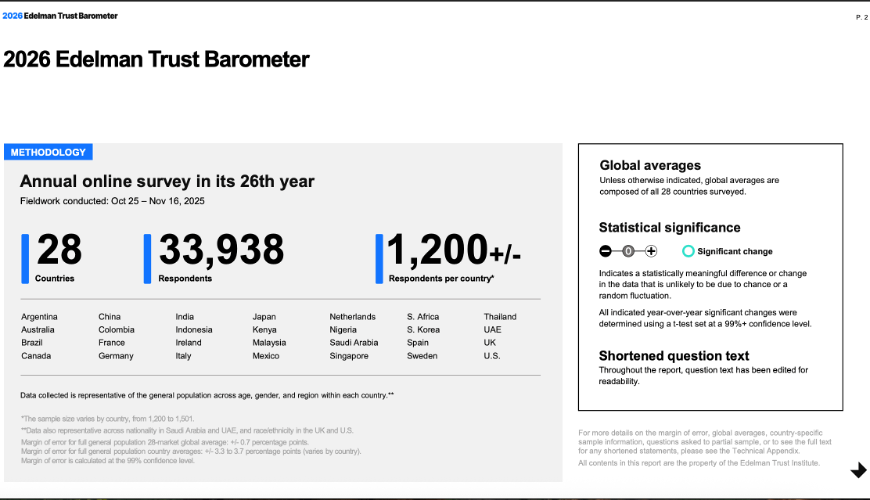
Edelman has been running a global trust barometer for twenty-six years — 28 countries, nearly 34,000 respondents in the most recent wave.
And the finding JH brought to the live is not a prediction. It’s history. Look at their own timeline of the last twenty-six years and you’ll find 2005: Trust Shifts from Authorities to Peers. Then 2006: A “Person Like Me” Emerges as Credible Spokesperson.
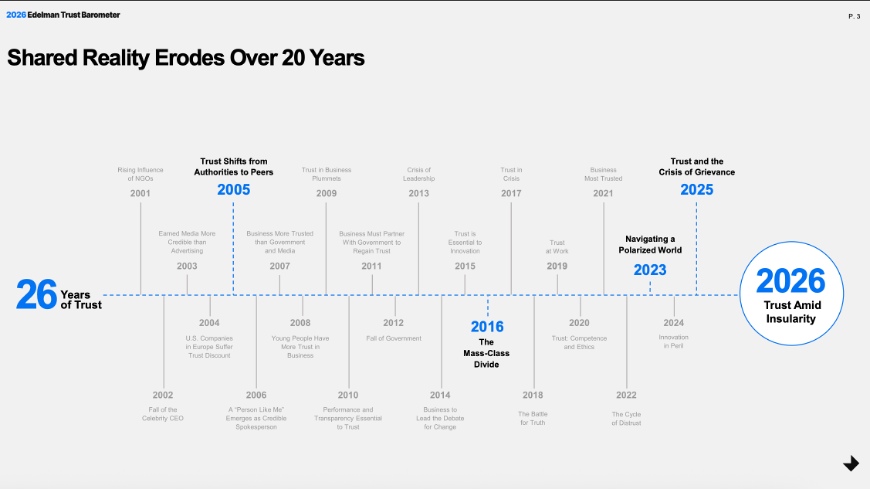
Twenty-one years ago, the most-watched trust study on earth logged the handoff. People started trusting people more than they trust institutions — more than brands, more than companies, more than the credential and the letterhead. It has only deepened since.
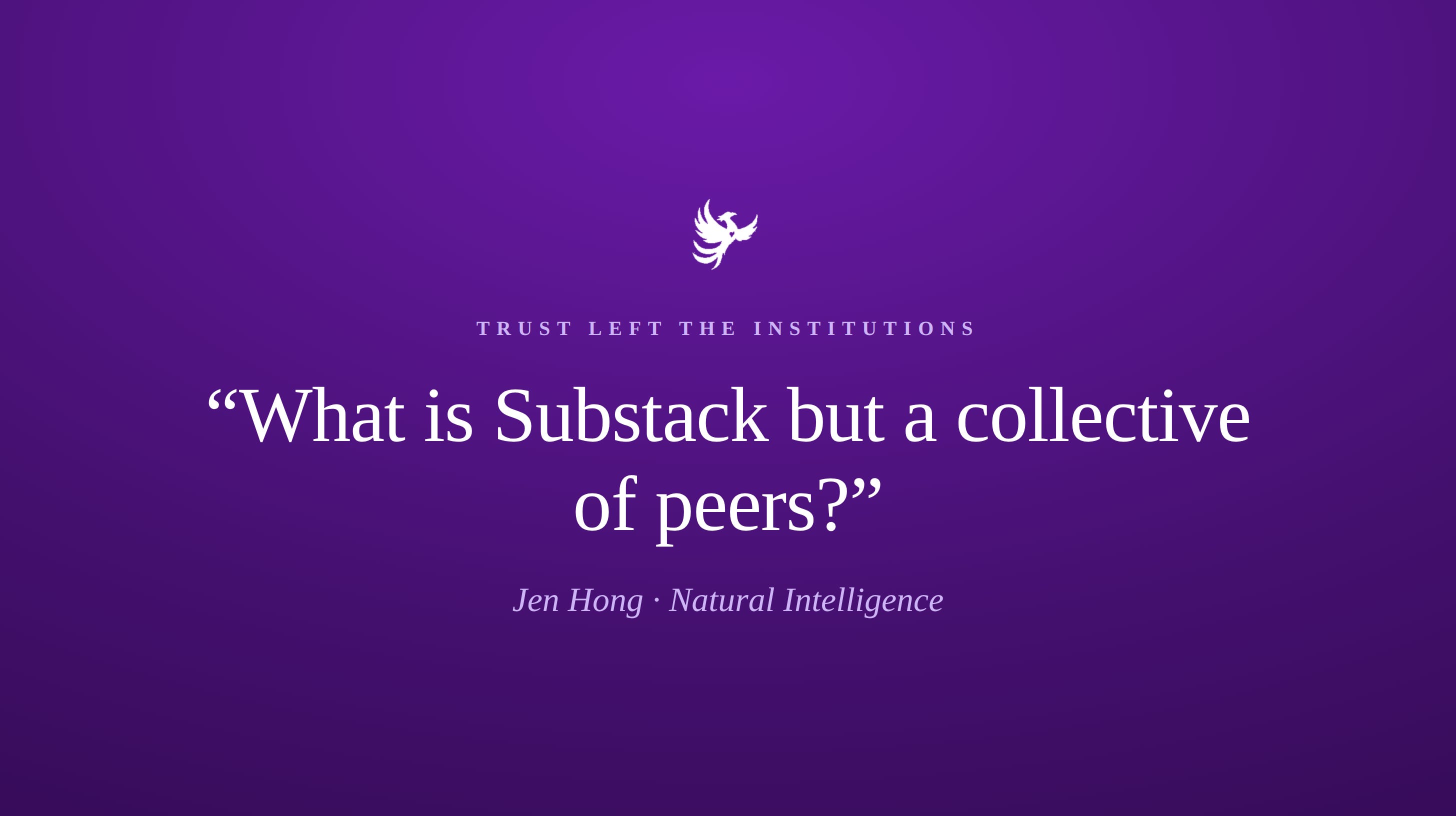
And then JH said the line that runs this whole piece: “What is Substack but a collective of peers?”
Trust used to be something you borrowed. You got yourself inside an institution — the masthead, the firm, the license, the logo on the building — and the institution loaned you its authority, and that loan was most of what people were responding to when they responded to you. The whole architecture of a career was built on securing the loan and keeping it in good standing.
The loan is being called in. Not because institutions vanished, but because the trust that made the loan valuable has relocated — into individual people who are visible, consistent, and recognizably themselves. Whatever authority used to arrive attached to a job title, you build yourself, in public, over time.
This is why the personal brand cannot wait.
Worth naming clearly: this is a different thing from influencer marketing, and both are legitimate. JH has funded influencers from the brand side, where they function as media — a paid channel, carrying someone else’s message. I sit on the other side of that line too. I do influencer and UGC work, drink brands and pet brands, and I genuinely enjoy it mostly, which is exactly why it’s useful to have seen the industry from both directions. The difference isn’t quality or worth. It’s ownership. In a brand campaign you carry a message you were given. Here, the message is yours, and the subject matter almost doesn’t matter. For me it’s brand and neurodivergence. For her it’s how AI touches humanity. The trust isn’t in the topic. It’s in the person.
Which is also, she thinks, part of why lives work. She watches her numbers a little intensely — “I try to hold it loosely, but as a marketer, I’m like, ooh, data” — and she sees people subscribe faster off a live than off a post, even adjusting for views. Her read: you get a clearer sense of who a writer is in an hour of unedited talking than in months of careful prose, so the trust arrives sooner.
In our call, JH did not say you can’t grow without showing your face. She said trust builds faster when people can watch you think. There’s more than one way to do this platform, and there are writers building beautiful, thriving publications who have never once gone live.
Don’t build for the machine
One of her core positions is that you shouldn’t create anything for the algorithm, and she has the perfect example.
Matt Damon said in an interview that while making a series for Netflix, the notes came back that he needed to restate the plot every seventeen minutes — not because the story was confusing, but because nobody watches a whole episode in one sitting anymore. So you write the show to accommodate a distracted person.
“You’re building for strange audience behavior,” she said. “Rather than just saying, make a super compelling story.” Her alternative objective is better and it’s simple: make something so gripping that sitting through seventeen unbroken minutes isn’t the sacrifice, it’s the point.
I felt that one in my teeth, because I spend time editing product videos where some of the cuts are under seven-tenths of a second — I have to change the frame that often to hold anyone.
JH shared that when she started, she followed every best practice she knew: character limits, frequency, the pithy one-line note trying very hard to be spiritual and profound. She’s embarrassed by them now, mostly because you can hear the trying. The notes that actually took off were the opposite — long, dense, borderline-should-this-be-a-post. Little encyclopedias.
“I am verbose, and that is authentic,” she said. “So it takes me a while to reach my point. And that’s okay. Some people like that.”
The rug in the yard
At a few hundred views, she said, everything is lovely. The AI writer community could not have been more welcoming to her — a lot of untraditional types, hardcore tech nerds without the résumé anyone would demand of a tech nerd, all of them generous. It’s when a post crosses a thousand or two thousand views that the weather changes. “There’s a rug out in your yard and it’s rained. And like six months later, you turn the rug over.”
That’s where the trolls are. The big posts turn the rug over.
AI is a lightning-rod topic, and she knew writing about it would draw some fire. What I want to point at is that it didn’t change her voice one bit. AI writing skews heavily male, and JH being in that room sounding exactly like herself matters enormously to readers who haven’t yet watched someone who looks like them hold that particular microphone.
Then there’s the thing she did that benefits every person reading this. When Substack rolled the Pangram AI detector into the platform — the tool that lets other users scan your writing and stamp it human or machine — she didn’t accept it quietly. Neither did the writers who went first: Carey Lening and Marion Pandora, both in Europe, where GDPR Articles 21 and 22 make parts of that integration non-compliant. They shepherded JH through it, and she worked out how to do it as a Californian, citing state law. For a couple of weeks it was a crowdsourced legal scavenger hunt — what’s your jurisdiction, which statute do you cite.
Then Substack did something JH gives them real credit for: they got imaginative and dropped the requirement entirely. People simply wrote in and said I didn’t consent to this and got a note back saying it had been disabled for them. Three weeks later, anyone can email and have it switched off at the account level. You don’t have to pretend to be a lawyer.
Her framing is the one worth keeping: this was not a consensual integration. The endgame is obvious — it should be a toggle. On or off, your call, no manual work.
She gets thank-you tags now from writers she’s never met. “I’m like, who are you? I don’t know you.” That’s what it looks like when one person asking a fair question becomes everybody’s default.
Processing, or preparing
We spent a good stretch on dreams, because she’s been reading Carl Jung and I’ve been having a recurring one I can’t shake.
Her working frame: a dream is doing one of two jobs. Processing something happening now, or preparing you for something you can already sense on the horizon. Jung called that second one the prospective function, and it’s the part most people never hear about. A dream about someone from your past is usually less about them than about who you were with them.
The method is the part I’m going to start doing. She’s built what she calls her woo-woo chat in Claude — deliberate context engineering for the unexplainable. Her birth chart lives in it. Her human design blueprint. Her gene keys. Transcripts of psychic readings recorded over the years. And her dreams, dictated half-asleep into her phone before they evaporate, typos and all. When she wants to work one, she asks for a Jungian lens on the symbolic and archetypal layers first — with no context about her life at all — and only then feeds in what’s happening, to see what connects.
“It remembers the arc of your dreams more than any person would.”
That’s Boss the Bot in its purest form. She isn’t asking a machine what her life means. She’s using it to hold a record no human memory can hold, so that she can do the meaning-making herself. She did my birth chart on the same principle, which was one of the best things anyone has done for me this year.
We were both wild children in college, and her position is that rebellion is a form of agency — it’s how you take something into your own hands and find where the boundaries actually are. There are consequences, and consequences are exactly how you learn where the edge is. Rebellion that never gets to happen doesn’t evaporate. It waits. And comes out sideways!

The era to receive
JH has lived most of her life in what tarot and a lot of other traditions call the masculine force — non-gendered, all initiation. Deciding you want something and going to get it. Live abroad. Switch careers. Go get the degree. “See, I did it. See, I did it.” It worked, repeatedly, which is exactly what makes it hard to put down.
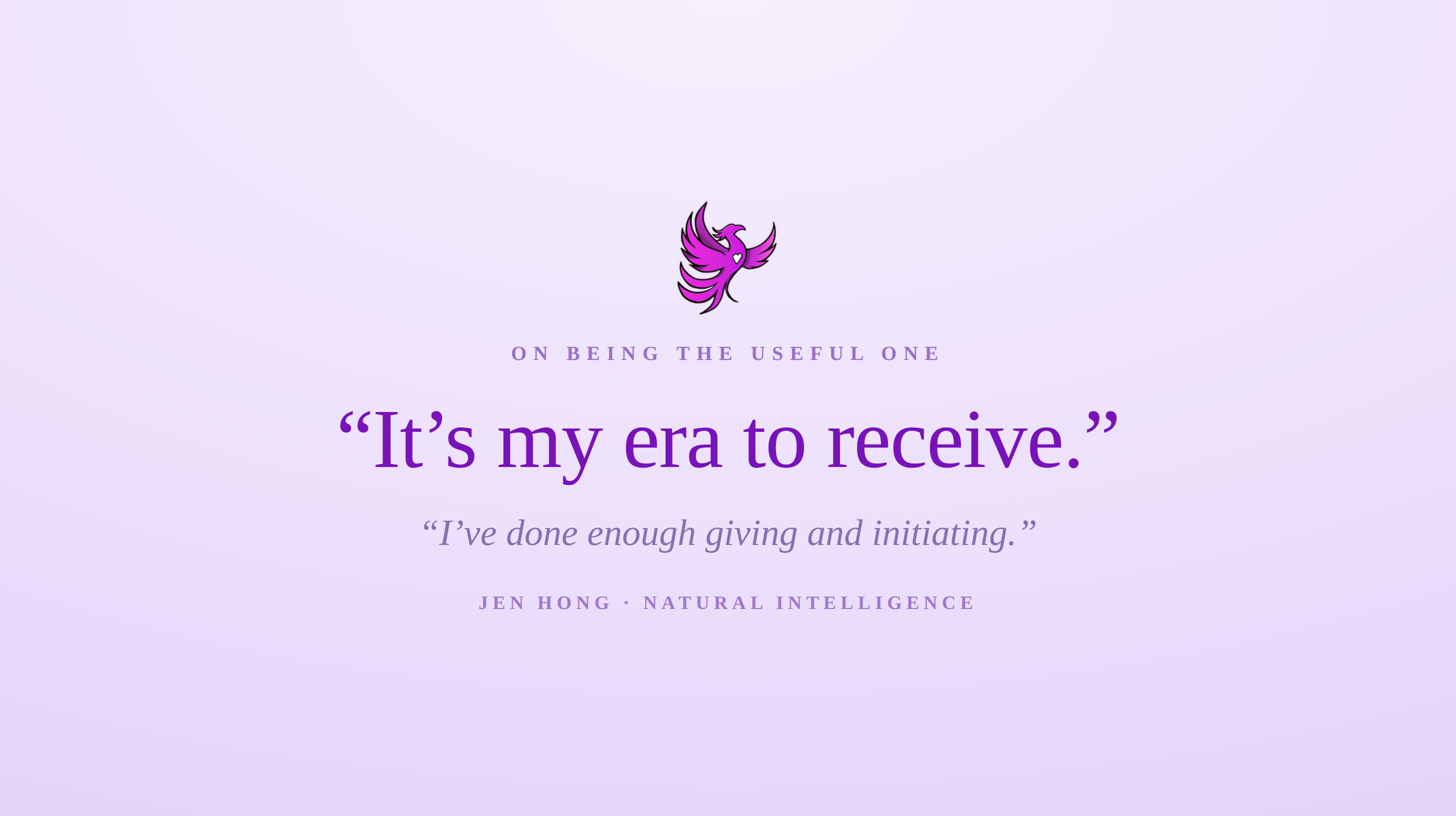
She’s cultivating the counterpart now, which is about receiving. Her words: “It’s my era to receive. I’ve done enough giving and initiating.”
I asked where the giving came from.
“I think it’s a wound.”
She thinks it’s no coincidence she chose marketing — she’s constitutionally the person who decides you need the thing and then sends it to you. Visit her house without owning a decent water filter and one is arriving at yours by Friday, because you deserve small delights in your day. Underneath the generosity, though: I need to be useful to people. I have to be accretive in some way. It can’t just be me.
Being loved for what you produce teaches you very early that being is not sufficient.
And it loops back to the little girl in Los Altos, reading a room nobody had given her the code to. So much of what makes us extraordinarily good at our work is scar tissue we learned to bill for.

Everybody’s audience is here
I asked her the last question: what would you say to the person who’s afraid to post, or afraid to post as themselves?
The user base is broad enough that everybody’s audience is already on it — they might not share your country or your age bracket or a single demographic box with you, but they’re here. And you will find them faster by sounding like yourself, because people can tell. It might not be the quickest route to a big number. You may not be on Le Concorde like Dr Sam Illingworth or Mia Kiraki 🎭 but the people who need to hear what you’re saying will find you.
“You’ll get there faster if you start being authentic today.”
She’s living the logic of the trust research without calling it that — which is also why she loves what Not Rising is doing, curating writers by hand precisely because a human is better than an algorithm at knowing who deserves to be found.
So my honest question for you, and I’d love it in the comments: what part of yourself are you still editing out of your writing because you assume nobody wants it?
The verbose part. The unhinged notes. The birth chart, the dream journal, the rooster named Larry David, the whole unbuttoned business. My guess is that’s the part your people are waiting for.
Go subscribe to Natural Intelligence — she’s one of the sharpest marketing minds I know and one of the funniest people on this platform, which is an unfair combination. And reach out to her. People have found professional work through her here, which is its own small proof of the thesis.
Leave a comment. Tap the heart if this found you at the right time — it helps more people find the conversation.
xo Jen
If you’re new here..
I'm Jennifer (Jen), and I write The Divergent Talent Alchemist about neurodivergent burnout, giftedness, and coming home to yourself. My work is lived experience first, research second — walked alongside you, not handed down from above. I'm building a community of creators, feelers, and rebuilders, plus a cohort for the ones ready to do the deeper work together. If you've ever been called "too much," you're in the right place.