A quick note before we start: this one touches grief, addiction, and the culture that taught a lot of us our worth was something we had to earn. If today’s a tender day, come back when you’ve got the room. The book will keep.

My beautiful cousin Nicole gave me a book before she passed away.
I was in fourth grade. She was twenty-nine. A drunk driver took her, and one of the few things of hers I still have is a signed copy of The Giving Tree — her handwriting inside the cover. She showed me makeup for the first time too (MAC, of course). I’ve still got an Express bag of hers and a pair of her sweatpants. Her parents — my aunt and uncle — are two of the kindest people walking this earth. My aunt went on to build an organization in Nicole’s honor and for her son, and she’s fought for grandparents’ and children’s rights ever since — a lifelong inspiration to me.
Nicole was taken too soon, and she handed me a children’s book I wouldn’t really understand for another twenty years.
That’s the thing about the books we get read to us as kids. They’re patient. They wait.
My friend Carole Cox has been a family-systems therapist for forty-five years. She’s also been my mentor, my safe place, and the person who once told me something I hung up the phone over — we’ll get there. We grabbed our favorite coffee, sat down with three dogs at our feet, and tag-teamed our way through the kids’ books that turn out to have been for the grown-ups all along. You can watch the live video above.
Here’s where we went:
• The Giving Tree — and the kind of love that doesn’t keep a tab
• The Hundred Acre Wood — where nobody tried to fix anybody
• The Velveteen Rabbit — why getting worn down is how you get real
• “Why can’t you be more like —” — the comparison machine, and how to retire it
• The day Carole told me to go work in a garden (and I was pissed)
• Kintsugi and crumpled paper — the parts of us we keep trying to throw away
The book my cousin signed
If you haven’t read The Giving Tree in a while: a boy grows up alongside a tree, and across a whole life the tree gives him what he needs. Apples to sell. Branches for a house. Her trunk for a boat to sail away in. And at the very end, when he’s old and worn out and asking for nothing but a place to rest, she gives him her stump to sit on.
I read it as a kid and saw the boy. Carole read it as an adult and asked the better question — what about the tree? The tree gives without keeping a tab. She never once judges the boy for the life he chooses. She doesn’t talk him out of sailing away. She doesn’t guilt him for staying gone. When he finally comes back, smaller and emptier each time, she’s just glad to see him.
There’s a parenting lesson in there that’s hard to swallow: love that doesn’t audit. And there’s a worth lesson too. Even as a stump, the tree still has use. Carole had a giant oak in her yard die and hollow out — so before it came down, she painted a little fairy door on it, and after, she cleaned out the stump and turned it into a planter. Flowers in it now. Still giving, in a new shape. People are like that, and we forget it constantly: you don’t stop having worth because your form changed.
The other thing the tree understood is that nature doesn’t ask you to perform. A huge part of my own healing has just been going outside and lying in the grass looking up at the sky — no system, no rules, nothing to be the best at. We get shoved into systems early. School lines you up. Work hands you a hierarchy. Reconnecting with the one thing that wants nothing back from you turns out to be medicine.
Nobody tried to change Eeyore
You know the reading that goes around about Winnie the Pooh — that each character is carrying something. Eeyore and his weather. Tigger, who’s apparently too much. Rabbit and his very particular way of doing things. Owl in the corner being wise. I’m not going to hand you that as a clinical diagnosis; it’s a folk reading, and it’s a generous one. Here’s what makes it land: nobody in the Hundred Acre Wood ever tries to fix any of them. Nobody tells Eeyore to cheer up. Nobody tells Tigger he’s too much for the group. They just let each other be exactly who they are.
A. A. Milne wrote a lot more into those animals than the size of the book lets on. So did Charles Schulz — Charlie Brown was basically Schulz himself, there really was a little red-haired girl, and so much of what he drew came straight out of his own life. That’s why you feel less alone reading it. You’re not reading a character. You’re reading a person who decided to tell the truth in a way small enough to fit in a kid’s hands.
Carole catches me jumping around mid-thought — I’ll call it a Tigger tangent, because if Tigger’s our ADHD stand-in, then so am I — and she doesn’t make me feel bad for the leap. That’s the whole point of the wood. We both get a little electric when we hit a truth we want to share. Nobody at that table is trying to file the other one down.
Real is a thing that happens to you
Carole led us into The Velveteen Rabbit, and this is the one that gets me. The Skin Horse — old, loved threadbare, most of his fur rubbed off — tells the new rabbit how toys become Real. Not by being shiny. Not by being kept careful on a shelf. Real isn’t how you’re made — it’s a thing that happens to you, slowly, by being loved hard enough to get worn down.
Your worth doesn’t come from staying new, or trendy, or unscratched. It comes from genuine connection and the mark you leave on the people who loved you.
The rabbit who got carefully kept and admired from a distance never becomes real to anyone. The one who let himself get shabby did.
Carole still remembers her first stuffed animal — a lamb from the sixties, back when they put actual wire inside the things. She loved that lamb until the wire started poking out through its legs. It went up to the attic and eventually it was gone, but it had already become part of her heart, which is the only place a toy was ever trying to get. I was the kid who felt guilty if I didn’t give every stuffed animal equal love and playtime — so The Velveteen Rabbit didn’t have to teach me that toys had feelings. I’d already decided.
This is where I read everyone a poem — Becky Hemsley’s “Breathe.” I won’t reprint it here (go read it from her, it deserves the whole thing) — but the arc is a girl who’s told she’s too loud and too quiet, too much and not nearly enough, by turns, depending on who’s grading her that day. Until she walks into the forest, tells the trees everything she’s been told, and finds that they ask nothing of her. They just let her breathe.
That’s the cost of getting real. Vulnerability hurts. You get worn down, you get heartbroken, the wire pokes through. But hidden, careful, shelf-kept parts can’t be loved — because nobody can see them. Our scars aren’t ugly. They’re proof of a life lived and deeply loved.
“Why can’t you be more like —”
Most of us got handed a sentence that starts that way. Why can’t you be more like your brother, the star. Your sister, the straight-A. We learn to perform for our parents, then our teachers, then our managers, and we end up empty inside and not entirely sure why. We base love on performance, so we keep performing, and the realest parts of us never get a turn.
The message I got was push through. Be the best. On the field you kick ass, you take people out, you win. And on paper that’s exactly what I did — Division I scholarship, the degrees, the certificates, the whole résumé. But that’s not actually who I am. I’m artsy. I’d rather connect with a person than climb past them. I’m not a rules-follower — hence The Divergent Talent Alchemist. Part of growing up is the slow work of sorting which of your operating beliefs are yours and which ones you inherited and never questioned.
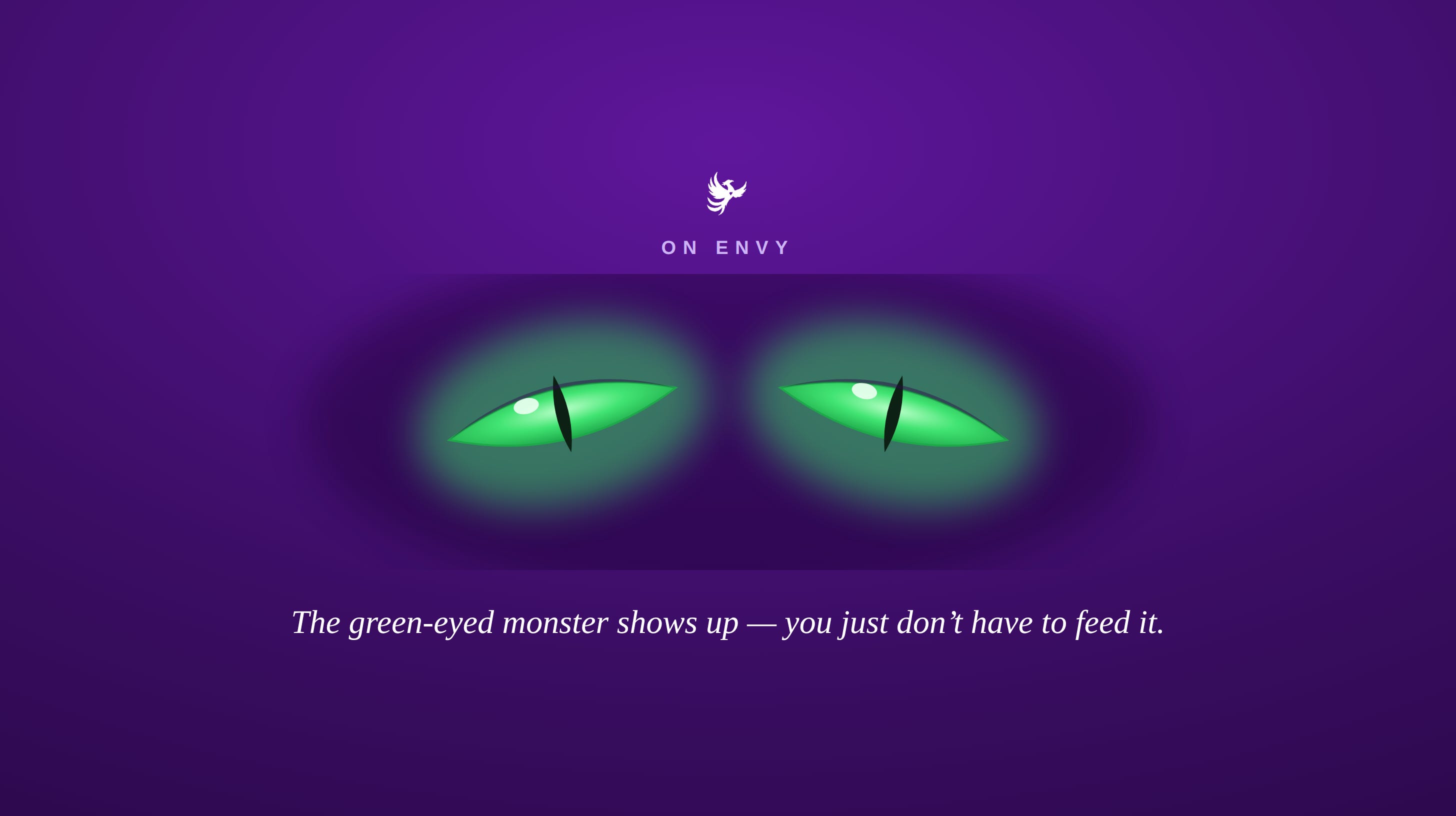
Carole gave me the cleanest version of how you actually shift this, and it came from her trumpet. She’s been playing for over fifty years and she’s back in a big band doing improv, and she’ll hear a guy pick up his horn and just go, and feel the green-eyed monster show up. Envy. The wish to be him. Her move isn’t to shame the feeling — it’s to notice it, name it, and then turn it: I love that he can do that, and I have my own style. Not yes-but. Yes-and. The opposite of envy is celebrating someone else, and the funny thing is that the celebrating is what frees you to sound like yourself. There’s room for everybody. There has always been room for everybody.
The day Carole told me to go work in a garden
After my big panic attack — the one where I ended up in the hospital, the one I talk about — Carole told me I should be doing some other kind of work. In a garden somewhere. Not in corporate. I was so offended and thought “Who does this woman think she is?” I could do this. I was made to push through, remember?
She was right. It just took me a while, because I’d been wired since I was small to prove I could survive anything. No job is worth your mental health. I’m not telling you to quit tomorrow and go pick flowers for a living (unless you can because this is beautiful) — we all live inside the same money system, and I’m not pretending otherwise. I’m telling you to make the small, incremental changes, the kind that actually hold. And to carve out space for healing with nature and just being.
Part of why corporate cost me so much is that I don’t see hierarchy. I don’t care what your title is — a CEO puts their pants on the same way I do. From a neurodivergent place I’ve got real resistance to authority-for-authority’s-sake, and the rigid version of that world was exhausting to survive in with my wiring.
A manager and a leader are not the same animal. A real leader doesn’t show up performing certainty — they make room for you to learn yourself; they give feedback in real time; they skip the games. I’ve had very few of those. Carole’s one. Lisa is another. My aunt and uncle, another. It takes a village, and I finally know what that phrase means.
Carole’s thirty years ahead of me — she’s in her sixty-sixth year, I’m thirty-six — and the thing she keeps saying is don’t wait until you’re my age to learn this. It’s not linear. You’ll backslide. The boy in The Giving Tree doesn’t learn it all at once either; he learns it across a whole life, one return trip at a time.
Kintsugi and crumpled paper
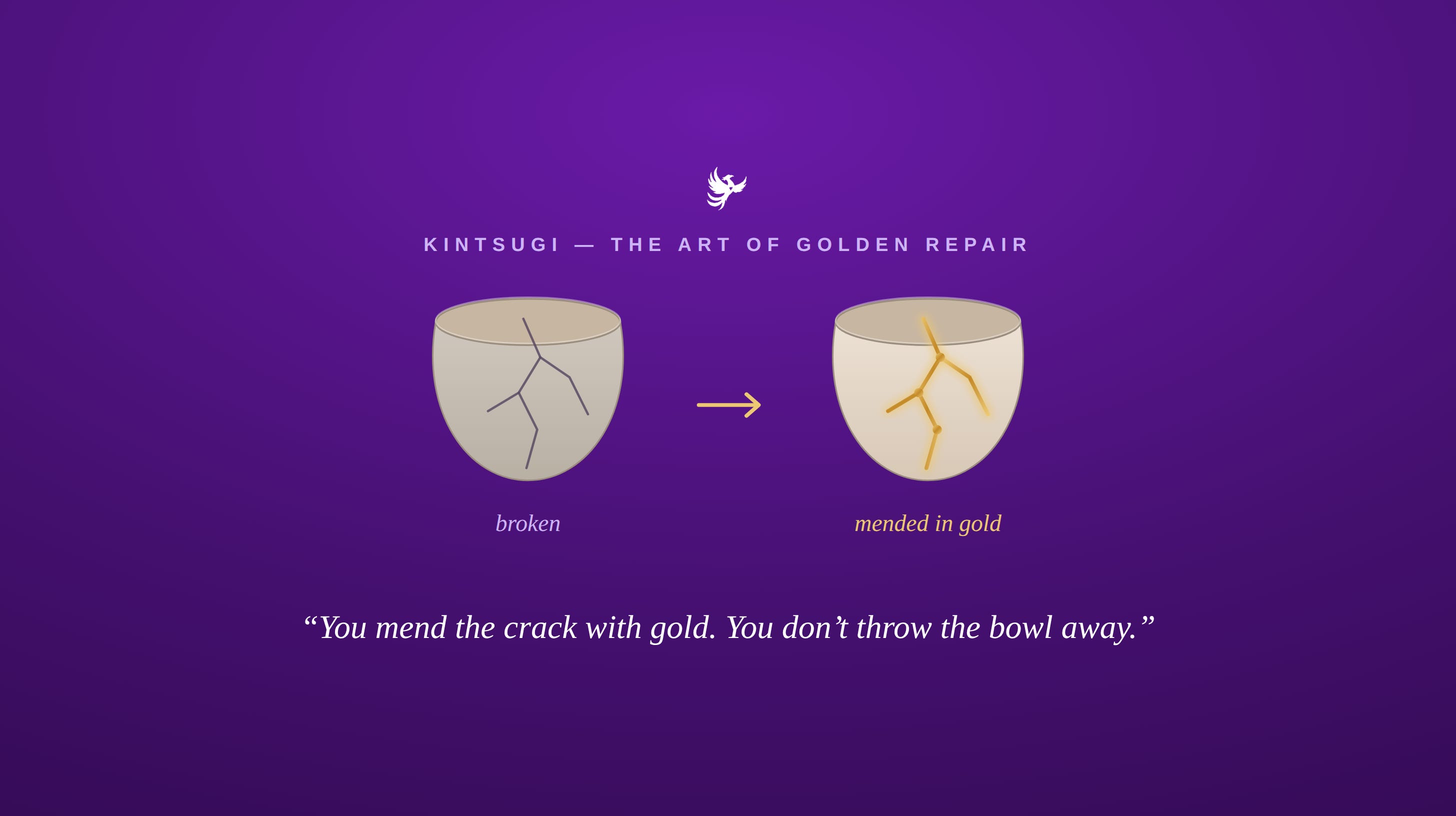
Carole pulled up a Japanese word for us: kintsugi. When a bowl breaks, instead of tossing it or hiding the damage, you mend the cracks with gold. The repair becomes the most beautiful part of the object — the fracture, lit up, is the point. It belongs to a wider idea called wabi-sabi: beauty and meaning living right inside the imperfection.
I grabbed a piece of paper off the table and crumpled it in my fist, because I’d seen someone do this once. Smooth it back out and the folds never fully leave. Set it next to a fresh sheet and you can see plainly: this one’s been through something. And it’s still a good piece of paper. It still works. You can still write on it. The trauma is visible and the worth is intact — both true at once.
Which is, more or less, the model Carole works from. Internal Family Systems — Richard Schwartz’s work — starts from a radical premise: there are no bad parts. The pain we can’t hold, we exile. When something pokes that exiled part, the firefighters rush in to drown it — alcohol, shopping, food, whatever shoves it back down. And the manager part runs around up top making sure we look perfect, so no one finds the wound. The work isn’t to amputate any of it. It’s to go back to the hurt part, let it know it’s loved, let it set the burden down, and let it come home. You mend the crack with gold. You don’t throw the bowl away.
Carole learned a version of this as a kid, watching a man named Smokey work alongside her mom at the Red Cross. Gray-haired, been through addiction himself, and the most effective person in the building — because he’d been through it. People felt their own brokenness recognized in his. That’s the whole thing. The restructured-after-breaking people are so often the ones who can actually reach you.
This is also the answer to why my page can look like it’s all over the place. Nervous-system regulation one week, family systems the next, branding, AI, wellness. There’s a through-line, I promise: the gaps. What you didn’t get in school. What your family couldn’t give you. What the workplace was never built to hand you. The systems are designed for a certain kind of person — B. F. Skinner was already saying the system wasn’t working decades ago, fighting for individualized education we still mostly don’t have. So we fill the gaps, and we build somewhere to belong while we do it.
The part that’s actually mine
Here’s the lived part, the bit no one could ghostwrite for me.
I picked up a soccer ball a few weeks ago for the first time in almost a decade. That sounds small. It wasn’t. I started playing at four. Scholarship, concussions, knee surgeries, the whole identity built on it — and when I left undergrad, I had no idea who I was without the field. After I got my final concussion playing recreational indoor soccer, I just... didn’t touch a ball. For years. The fact that I could juggle it again, knowing full well I’ll never be that twenty-one-year-old athlete again and being okay with that, was enormous.
Five and a half years ago I also put down alcohol, and that changed everything. Here’s what nobody warns you about: take the numbing agent away and all the buried stuff floats straight up. Things you’d forgotten. Things you’d worked hard to forget. It’s been about six years of unpacking and I’m still at it every single day. I’m telling my story this month on Josh Woll’s podcast, Clear Conversations. You can add the conversation to your calendar using this link.
I also wrote letters to my younger self. And a children’s book, Jen’s Bright and Bouncy Brain, about ADHD and anxiety in childhood — because I want kids and parents to understand their own brains and nervous systems sooner than I understood mine. (Carole, if you’re reading this: I still want you to illustrate it.) This will eventually be on the market, but I am taking my time.

Before you go
So here’s my honest question, and I’d love your answer in the comments: which children’s book was quietly raising you the whole time — and what’s the lesson you only caught years later?
And while we’re here — which crack are you still trying to sand smooth instead of fill with gold?
Leave a comment. Tap the heart if this reached you (apparently that helps it find the next person).
Applications for the first The Divergent Brand cohort are open through June 19, 2026 if you want somewhere to do this work alongside other creators, feelers, and rebuilders. Carole and I are cooking up something community-shaped for after that — tell us what tools and resources you want more of.
The books were never just for the kids. We just had to grow up enough to hear them.
xo Jen & Carole
Psst: if you want to learn boundaries, start here.
Thank you Marianne McCourt, Phil Powis ❤️⚡️ ,Colleen Kenny, KarenC-Book Collector📚⚖️🗽🗳️🧿♒️, and many others for tuning in!