It started with a Note.
Natalie Hewitt wrote that her ADHD dream job is professional ideas generator, and it went viral — because thousands of us read it and thought, oh my gosh, me too. I quoted her in my piece on polymaths and multipassionate professionals, and last Friday we finally sat down together, live, to have the conversation that Note started.
What I got was so much more than a chat about dream jobs. Natalie is a school counselor at an international school in northeast China, a former teacher, a mom raising teens abroad, and the writer behind Rooted N Chaos — and she is, truly, a fountain of knowledge on the things almost nobody is talking about: what happens when ADHD and PMDD live in the same body, why so many of us get handed a bowl of Alphabet Soup™ instead of whole-person care, and what it takes to stop apologizing for the brain you have.
A gentle note before we begin: this piece touches on PMDD, dissociation, and misdiagnosis. Take what serves you and be tender with yourself around the rest.
Here’s what we’ll cover:
- The viral Note and the woman behind it
- PMDD 101 — and why women with ADHD need to know about it
- The estrogen–dopamine connection your doctor probably never mentioned
- Alphabet Soup™: ADHD, PMDD, IBS, and the case for whole-person care
- The toolbox, not the tool — Natalie’s approach to the execution gap
- On unmasking at work (and why “hot mess” is now on the table in interviews)
- Careers as ecosystems — and whether Natalie is already becoming her dream job
Everyone’s body is different, so take all of this as a starting point, not a prescription — your provider (or providers, if you’re collecting them like the rest of us) know you best. But I hope it helps you ask better questions.
The woman behind the Note
Natalie didn’t know Substack existed until about six months ago. She was a teacher who kept finding herself drawn to the neurodivergent students — “they’re the ones I wanted to help, found most interesting, connected with” — and later, after her own ADHD diagnosis, she understood why. Now she’s a school counselor at an international school in China, certified in positive parenting, working with kids and families across cultures, and building something online so she can eventually work from anywhere. She and her family love traveling Southeast Asia; the dream is coffee by the ocean, a few hours of meaningful work, and a new country to explore.
The growth of Rooted N Chaos has been substantial — the viral Note, the “how to torture a neurodivergent” tips series people keep asking her to turn into a coffee table book, and messages she never expected. Two readers came back to tell her that because of her content, they got evaluated and diagnosed. That’s the flywheel that keeps her going. In her words: “I wanted people to understand themselves. I wanted to help people understand their kids. And to just bring some humor to it — because it is ridiculous walking into the same room 15 times and not knowing why you’re in there.”
Ridiculously relatable is what it is.
PMDD 101 — and why women with ADHD need to know this
If you’ve never heard of premenstrual dysphoric disorder, you’re not alone — neither have a lot of doctors. Natalie has had to explain PMDD to her own providers more than once, and the only doctor who ever recognized it on the spot was a resident, fresh out of med school, about ten years ago. “It was just ten years ago that they started actually teaching it in medical school,” she told me. Let that sink in.
The shorthand people use is “PMS on steroids,” but Natalie’s real definition is better: PMDD is the body responding negatively to its own normal hormonal fluctuations. Most women get a couple of moody days and some cramps before their period. Someone with PMDD can feel every fluctuation — Natalie knows when she’s ovulating, knows when she’s switching phases, knows her period is coming, because her body reacts to each shift. Before medication, she got about three good days a month where she felt like herself. Three. I know this feeling intimately too, and sometimes it requires a full day in bed doing absolutely nothing but being vertical.
One of the most misunderstood symptoms is dissociation — that out-of-body experience of watching yourself rage and telling yourself to stop, and not being able to. It’s one reason women with PMDD get misdiagnosed with borderline personality disorder: if a doctor never asks is it all the time, or only a certain time of the month, they’ll never see the distinction. The cyclical pattern IS the diagnosis.
And here’s the data every late-diagnosed woman deserves to have: research suggests women with ADHD are roughly three to four times more likely to experience PMDD than women without it — a 2025 study in The British Journal of Psychiatry found provisional PMDD in about 31% of women with a clinical ADHD diagnosis and 41% of those who scored high for ADHD symptoms, versus about 10% of those without ADHD, and an earlier clinical study cited within it put the figure at 45.5% versus 28.7% in the general population. That same research notes a recent meta-analysis found clinically confirmed PMDD in about 3.2% of menstruating women — and researchers believe the strict diagnostic criteria mean it’s undercounted. Meanwhile, an estimated 15.5 million U.S. adults have ADHD, over half of them diagnosed in adulthood.
Almost nobody is told any of this at diagnosis. That has to change.
The estrogen–dopamine connection
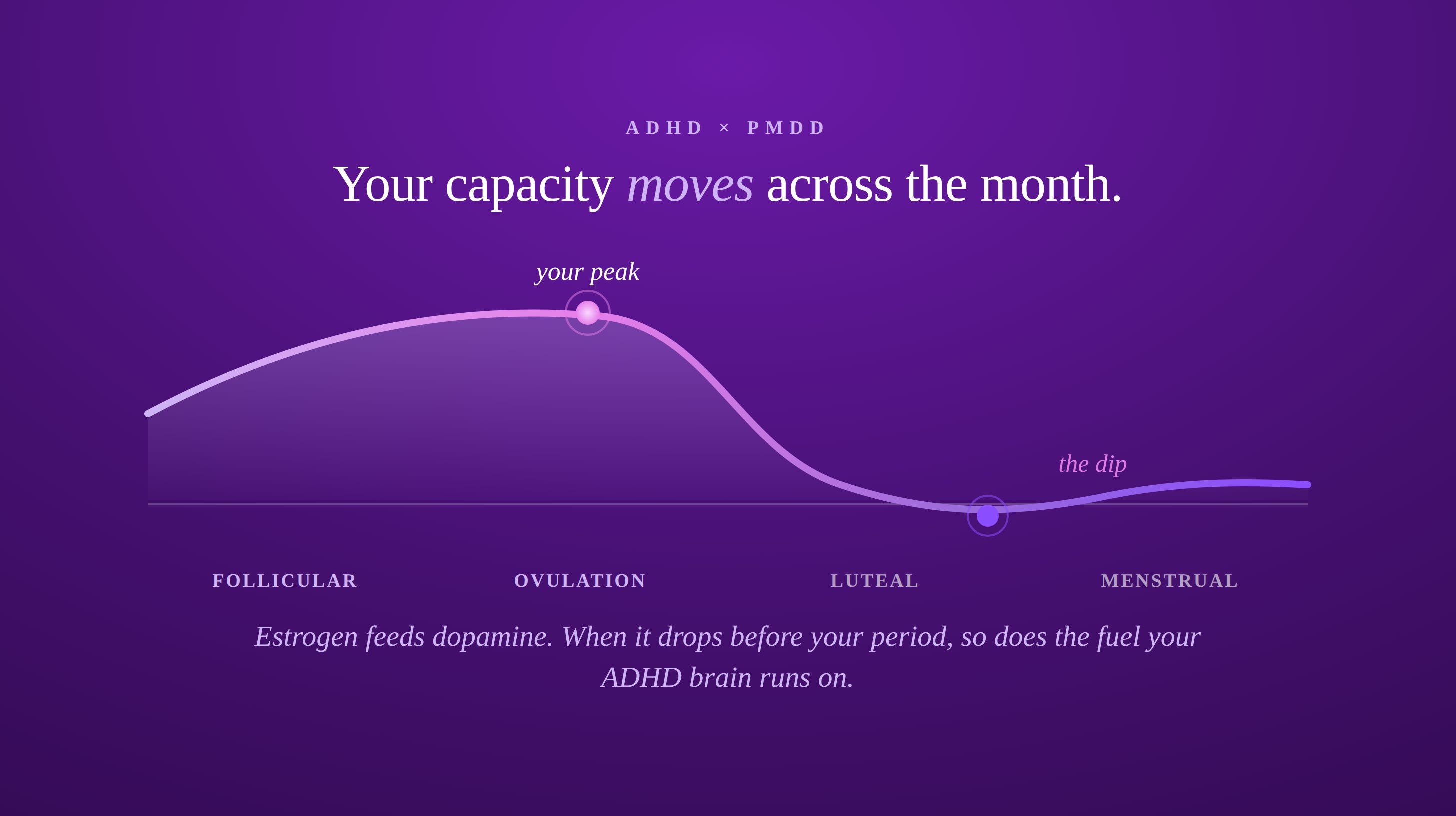
This is the part of the conversation I haven’t stopped thinking about. Estrogen affects dopamine — our hormones feed the very neurotransmitters the ADHD brain already runs low on. Natalie put it plainly: “With somebody that already has low dopamine, what’s going to happen when the hormones that create that dopamine are low? We’re getting even less than we’re used to getting. So our symptoms feel worse. Our depression feels worse.”
Which means ADHD and PMDD don’t just coexist — they compound. It also means your capacity genuinely changes across the month, and that’s biology, not a character flaw. A listener asked whether RSD gets worse when hormones fluctuate pre-period, and Natalie’s answer was immediate: absolutely, yes. And when I asked which phase we should be doing our best work in, she didn’t hesitate — the follicular phase, when estrogen is rising and you feel most like yourself.
Alphabet Soup™ — and the case for whole-person care
I call it Alphabet Soup™: the experience of collecting diagnosis after diagnosis — ADHD, PMDD, PCOS, CPTSD — until you’re left holding a bowl of letters nobody has taught you how to read, each one treated in isolation by a different specialist who never looks at the whole person spooning them all at once. The letters aren’t the problem. The problem is that our medical system keeps treating each one separately instead of treating the human they all belong to.
Natalie’s IBS story is the perfect example. She’s had upper GIs, lower GIs, years on the low-FODMAP elimination diet — “I call IBS the diagnosis they give when they can’t figure out what’s wrong with you” — and later learned there’s a growing body of research linking ADHD and gut/GI conditions like IBS “Had they ever stopped and asked, are you ADHD? I wouldn’t have had to have a lower GI.”
If somebody has ADHD, providers should be looking at the other things that travel with it. That’s the shift we’re both hoping to see — and it’s why Natalie works with Dr. Sarah Secor-Jones, a neurodivergent doctor in women’s health who provides neuroaffirming care and specializes in PMDD, with a whole community of doctors practicing the same way. (Natalie and Dr. Sarah have gone live together on this very topic — worth a watch if this section resonated.)
(Natalie also gave us a fascinating window into healthcare as an expat — navigating a tier-2 Chinese city of six million people, hospital liaisons, the newness of mental health care in China, and the cultural weight of saving face. That alone could be its own conversation.)
The toolbox, not the tool
When I finally asked her one of my prepared questions — how do you personally close the gap between the fountain of ideas and the follow-through — Natalie gave the most honest answer possible: “I’m still learning.”
But then she said the thing her whole platform is built on: “There’s never going to be one system or one strategy that works for us. We need a toolbox.” Our capacity changes day by day, week by week, cycle by cycle — so a strategy that works beautifully in your follicular phase may collapse in your luteal phase, and that’s not failure, that’s data. She doesn’t want to hand people a tool and say use this, it’ll work. She wants to teach people to build their own toolbox — that’s the big project she’s writing now. Natalie has shared a series with Dr. Sarah called The Period Chronicles, where they talk about each phase of the cycle.
A few tools from hers that I loved:
- The luteal ideas notebook. In her luteal phase, her brain floods with ideas — “grasping for straws for control,” as she describes it, because she knows she’s about to lose it. The ideas are good; the capacity to execute them evaporates. So she writes them down on a dedicated page and comes back when capacity returns. Has she gotten to all of them? No. Has she gotten to at least one? Yes. The point is she’s not losing them anymore.
- Listen to what’s pulling at you. Her most recent piece wasn’t the one she planned — it was the one screaming to be written, about the pull between living abroad and wanting to be near family.
- Every idea does not have to come to life. She’s still working on believing this one. So am I.
- Boss the Bot. We both use AI to dump the jumble out of our heads and find the common thread underneath it — because all of our ideas connect somewhere, and for Natalie that thread is always the same: helping people feel validated and seen, and teaching them to build their own toolbox.
This is the interest-based nervous system in action, by the way — Dr. William Dodson’s framework. Neurotypical brains engage through importance, rewards, and consequences; ADHD brains engage through interest, novelty, challenge, urgency, and passion. The idea IS the dopamine hit. Learning how your own engagement actually works isn’t a luxury — it’s the whole game.
“Someone will steal your ideas.” Yes. Write anyway.
A listener raised the question so many creators sit with: aren’t you worried AI — or people — will take your ideas? Natalie’s answer was one of the most grounded I’ve heard. Yes, it stings; she’s watched people mimic the exact format that took off for her. But somebody else may have had the idea before her too, and being angry about it “is just poison for me.” Buddha would agree! Someone on Substack once wrote something that stuck with her: yes, somebody has already written what you’ve written — but they haven’t written it from your perspective. Something I write and speak about often is how important it is to build your own personal brand, including stories from your world. Absolutely nobody can duplicate that, even if they try, there is only one you.
There’s only one Natalie — a counselor who teaches internationally, lives in China, writes Rooted N Chaos, raises her kids abroad, and misses her family in Oklahoma all at once. Nobody can generate that. Your story and your why are the moat; from a personal branding perspective, they’re the only moat that matters.
Unmasking, hot messes, and the interview question I can’t stop thinking about
I asked Natalie what she used to apologize for about her brain that she now considers a feature. Her answer was about job interviews.
She used to bring the polished version — makeup on, tattoos covered, rehearsed answers shaped around what they wanted to hear. At some point she decided: no. She shows up as herself now. Honest when she doesn’t have a good answer. Honest at work, too: “I need you to give me a deadline or it’s not going to happen.” Honest when she asks clarifying questions and someone gets defensive — “I’m not questioning you. My brain has no idea what you want me to do.” She’ll tell you plainly: “I am a hot mess.” And she no longer apologizes for it.
Here’s why that landed so hard for me. I spent years in talent acquisition. I wrote behavioral interview guides — churned them out — and it wasn’t until I stepped back, started writing on Substack, and processed my own workplace experiences that I saw it clearly: the behavioral interview is a performance. Tell me about a time you had a disagreement with a coworker. What are your top three strengths. And then we hire the person who answered best — not the person who can actually do the job. Both sides lose. The company performs its painted-on values, the candidate performs their rehearsed self, and six months later everyone is surprised the decision is wrong.
Unmasking in the interview isn’t just self-respect — it’s a screening tool. If naming what you need (deadlines, clarity, context) makes a workplace flinch, you’ve just learned everything you need to know. And as Natalie said, finding the people you can say it to is a game changer. Your team — and honestly, your manager — makes or breaks the experience. This holds true for clients as well in the entrepreneurial space.
Careers are ecosystems, not ladders
Near the end, I asked her the question underneath the whole conversation: given everything she’s building — the counseling, the writing, the parent presentations, the teacher tools, the workbook, the eventual LPC — is she already becoming the professional ideas generator from that viral Note?
Because here’s what I believe: careers are not ladders, they’re ecosystems of experience. Natalie connects things other people don’t connect — counseling, parenting, PMDD, ADHD, cross-cultural life — and puts them into the world in a way people can actually digest. That IS the job. It’s just never been titled that.
Her answer was honest, like everything else she said: she’s found it, and she’s still figuring it out. They say niche down; she says the niche will find you. What she knows for sure is the feeling she’s chasing — the parent meeting where she walks out thinking damn, I know what I’m talking about, the message that says because of you, I finally got diagnosed, the morning coffee by the ocean before a few hours of work that actually matters. That’s not a ladder anyone hands you. That’s an ecosystem you grow.
So let me ask you
What’s something you used to apologize for about your brain that you now consider a feature? And — be honest — do you know which phase you do your best work in?
Tell us in the comments.
Author’s note: Go subscribe to Natalie at Rooted N Chaos — her ADHD tips series alone is worth it, and her workbook on learning your capacity and building your own toolbox is one to watch for. Thank you to Dr. Sarah Secor-Jones for the neuroaffirming work she’s doing in women’s health, and to everyone who joined us live and asked such wonderful questions.
The replay is here for you to watch. If this conversation made you wonder about your own Alphabet Soup™, that’s worth a conversation with a provider who treats the whole person — and if it made you want to finally build a career around the brain you actually have, you know where to find me.
xo Jen